Assessment Team and Contributor:
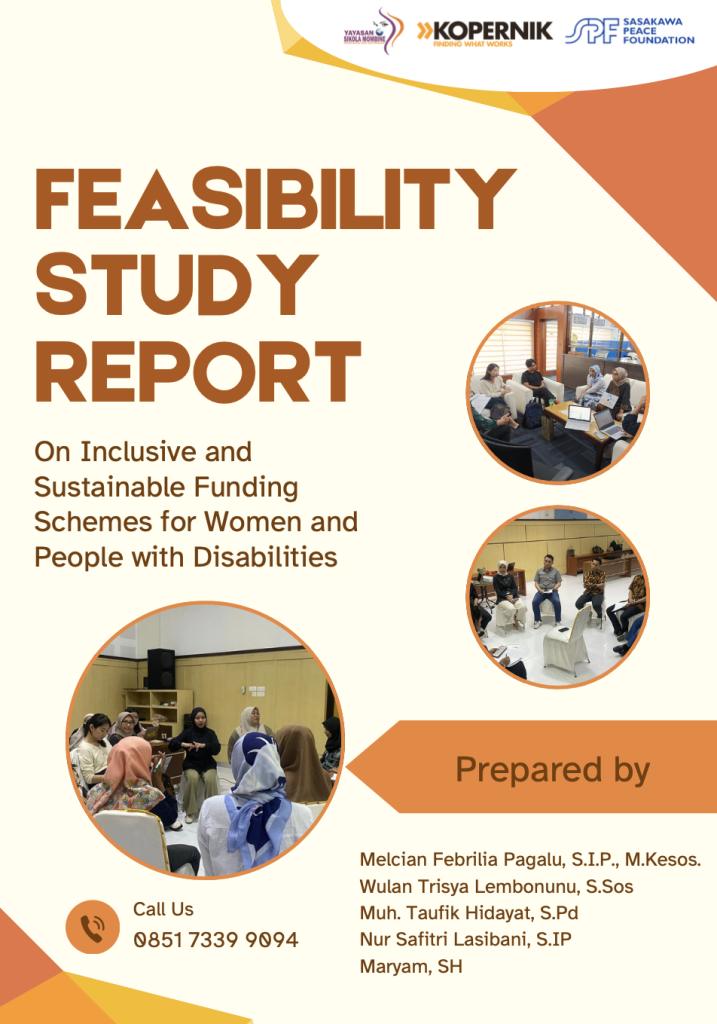
Melcian Febrilia Pagalu, S.I.P., M.Kesos.
Wulan Trisya Lembonunu, S.Sos
Muh. Taufik Hidayat, S.Pd
Nur Safitri Lasibani, S.IP
Maryam, SH
Published by:
Yayasan Sikola Mombine, KOPERNIK, Sasakawa Peace Foundation
Publication Year:
2025
***
Excecutive Summary:
Micro and small enterprises (MSEs) in Palu City play a vital role in supporting the local economy, including those managed by women and persons with disabilities (PWD). However, despite the considerable potential of formal financing estimated at IDR 419 billion annually from bank microcredit (KUR), government grants, corporate social responsibility (CSR) funds, and NGO assistance only about 30% of business actors are able to access these funding sources.
The main barriers lie in limited assets and legal documents for collateral, low financial literacy, the digital divide, as well as socio- cultural factors such as stigma and the double burden that restrict women’s mobility. For persons with disabilities, access is further hindered by financial service infrastructure that is not disability-friendly and the high cost of transportation. This situation highlights a gap between the need for small, flexible, and easily accessible business capital and the supply of formal financial institutions that tend to be rigid and demand heavy requirements.
This study integrates the framework of microeconomics (supply– demand), financial inclusion, and GEDSI (Gender, Disability, and Social Inclusion) to provide a comprehensive picture of the challenges and opportunities of inclusive financing schemes. The analysis underscores the need for more responsive and sustainable interventions, including the development of collateral-free microloans with low interest, hybrid models combining seed grants and revolving credit, as well as digital financial services such as the SANGU PALU application.
In addition, financial literacy training, business management, and digital marketing must be strengthened through continuous mentoring of at least 6–12 months to ensure that the use of funds is productive rather than consumptive. Inclusive financing schemes must also integrate GEDSI perspectives by designing disability-friendly services, training schedules that are adaptive to women’s domestic burdens, and involving local government agencies (OPD) and women’s groups in planning and monitoring.
Through collaborative support from government, banking institutions, cooperatives, NGOs, local communities, and academia, an inclusive financing ecosystem in Palu City can be realized to improve financial access, strengthen business capacity, and ensure a fair and socially just local economy.
***